Meme coin entry strategy
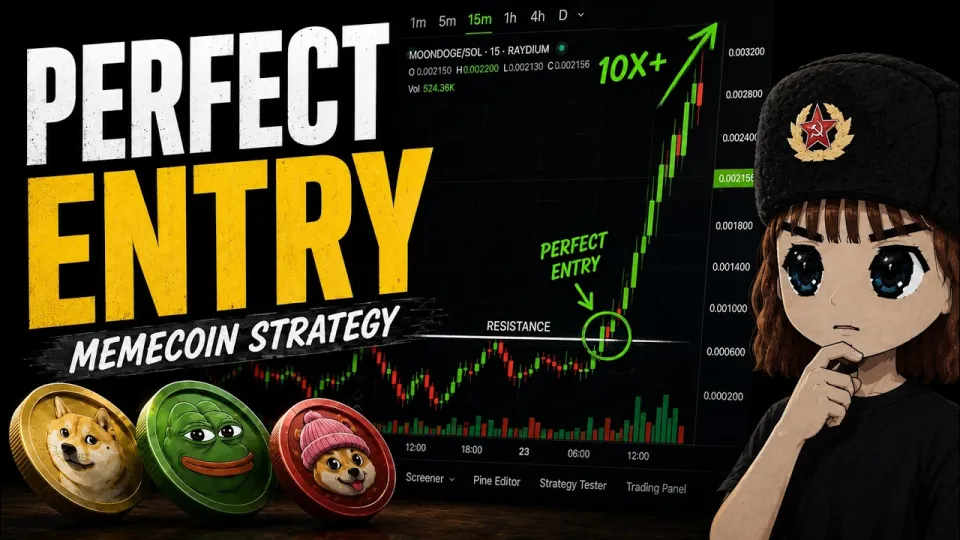
Video: How I Find the PERFECT Entry on Memecoins 📈 (Full Strategy)
You can order the same kind of articles for your own video to boost it on YouTube and Google. Just message the Telegram bot @sat_sit_bot. The bot writes and publishes the articles itself (with your YouTube video embedded) on popular topical websites (no ads). Your first 50 articles are free.
· based on the channel starwifpump
Key takeaways
- Most meme coin losses come from timing, not from picking the wrong token.
- The core setup is momentum confirmation plus a pullback into a support level, not a green candle chase.
- Invalidation signals — failed reclaim, lower highs, volume drying up — matter as much as entry triggers.
- Risk, exit and profit-taking levels are planned before the position is opened.
- Paper trading and a written checklist are the fastest way to build a repeatable entry process.
Most meme coin traders lose money not because they picked a bad token, but because they bought at the wrong moment. A meme coin entry strategy is a repeatable process for deciding when to buy: confirm momentum, wait for a pullback into support, define invalidation, and size the position before the order goes in. The full breakdown of that process comes from the starwifpump channel, and the tool stack discussed around it is collected in the Plasma Telegram early-access group.
Meme coins are among the most volatile instruments in crypto: liquidity is thin, narratives rotate in hours, and a token can double and halve inside a single session. That is exactly why entry timing carries more weight here than in almost any other market. A good narrative with a bad entry turns a winning idea into a losing trade.
Why entry timing decides the outcome on meme coins
On a volatile token, the difference between buying a breakout at the top of a candle and buying the retest of the same level can be a 30–50% swing in risk-to-reward. Entry price sets your stop distance, your position size and your tolerance for normal noise. If your stop sits far below your entry because you chased, every routine wick becomes a loss.
A useful mental model is that a meme coin trade has three separate decisions: what to buy, when to buy, and how much to risk. Most traders spend all their attention on the first and almost none on the other two. The process below is built to fix that imbalance.
The four-step entry checklist
A workable entry checklist has four gates, and a trade only happens when all four line up. Skipping a gate is how FOMO gets into the order book.
- Chart structure first. Look at the token's chart on a short timeframe and identify whether price is making higher lows, printing a base, or already extended far from its launch range. No structure, no trade.
- Momentum confirmation. Volume should expand with the move, not fade into it. Rising price on falling volume is a warning, not a signal.
- The pullback. Wait for price to return to a level that previously acted as resistance or as the base of the impulse — the retest is where risk is smallest.
- Invalidation in writing. Before clicking buy, write down the price at which the idea is wrong. If that level is more than a comfortable distance away, the trade is too late.
Reading momentum without chasing the pump
Momentum is information about participation, not a buy signal by itself. The trap is that the strongest-looking candle is usually the worst place to enter, because everyone who wanted in has already bought and the next move depends on new buyers arriving.
Instead of buying the vertical move, watch how price behaves when the move pauses. A healthy token holds its gains, consolidates sideways or drifts slightly lower on lighter volume, and then reclaims the prior high. A weak one gives back most of the impulse within a few candles. The reclaim of a prior high after a consolidation is a far higher-quality trigger than the initial spike.
Volume behaviour is the second filter. Expanding volume on the push and contracting volume on the pullback suggests holders are not rushing for the exit. The reverse — thin push, heavy pullback — usually means the move was driven by a small number of participants.
Using pullbacks and support levels to improve entries
Support on a meme coin chart is rarely a clean horizontal line, so treat it as a zone rather than a precise number. The most reliable zones come from three places: the base of the impulse that started the move, the level where the token previously consolidated before breaking out, and round psychological prices where liquidity tends to cluster.
The practical routine is simple. Mark the zone before the pullback arrives, set an alert, and decide in advance what you will do if price reaches it. When price gets there, look for a reaction — a wick that gets bought, a candle that closes back inside the range, or a quick reclaim of the zone. That reaction is your confirmation; the zone alone is not.
If price slices through the zone with heavy volume and does not reclaim it within a couple of candles, the setup has failed. Accepting that quickly is cheaper than averaging down into a broken chart.
Red flags that say do not enter
Knowing when to stay out is half of an entry strategy. Several chart signals consistently precede bad trades on meme coins:
- Price is already up several multiples from its launch range and the chart is vertical with no consolidation.
- Volume is declining while price grinds higher — the move is running on fumes.
- The token prints a lower high after a failed breakout, which signals sellers are in control.
- Liquidity is thin enough that a single sell order moves the price several percent.
- The only reason to buy is that the token is trending on social media, with no chart structure behind it.
Any one of these is a reason to wait. Waiting costs nothing; a bad entry costs capital and attention.
Planning risk, exits and profit-taking before the trade
Risk planning happens before the order, not after it. A practical structure is to fix the maximum loss per trade as a small fixed percentage of the trading stack, place the stop just beyond the invalidation level identified in the checklist, and let that distance determine position size — not the other way around.
Exits can be staged. Taking a portion off at the first meaningful resistance, another portion at a predefined multiple, and trailing the remainder behind higher lows keeps a winner from turning into a scratch. Writing those levels down before entry removes the temptation to improvise while the chart is moving.
The same discipline applies to tools. Paper trading a strategy for a few dozen setups before risking real money exposes whether the checklist actually works or just feels good in hindsight.
Common questions from newer traders
Newer traders tend to ask the same practical things, and the answers are usually about process rather than prediction. How do you screen for candidates in the first place? Most traders use tracker filters based on liquidity, age of the token, volume and holder distribution, then apply the chart checklist only to the shortlist. How do you catch announcements and social catalysts early? Social trackers and alert bots help, but a catalyst without chart structure is still a coin flip.
Does the same approach work on every chain? The mechanics of momentum, pullbacks and invalidation are universal, but liquidity depth and trading costs differ a lot between ecosystems, so position sizing has to adapt. And the hardest question: what if you have already lost money? The honest answer is to stop trading real size, paper trade the checklist until it produces consistent decisions, and only return with money you can afford to lose entirely.
Useful links
- Plasma Telegram early access — tooling, updates and setup help
- Discord community
- Padre terminal VIP access
- Solpump
- starwifpump on X
Bottom line
A meme coin entry strategy is less about predicting the next move and more about refusing bad ones. Confirm structure, wait for momentum to prove itself, buy the pullback into a marked zone, and define invalidation and exits before the order is placed. That single discipline changes risk-to-reward more than any indicator. The starwifpump channel built this breakdown around exactly that idea, and the Plasma Telegram group is where the associated tooling and early access live.
Questions & answers
What is the best time to enter a meme coin trade?
The best entries usually come on a pullback into a marked support zone after an impulse, not during the vertical move itself. You want momentum already confirmed by volume, then a retest where your invalidation level is close and your risk is small.
How do I avoid FOMO when a meme coin is pumping?
Decide your levels before the move happens and let alerts bring you back to the chart instead of watching green candles. If the only reason to buy is that price is rising fast, the setup is missing and the trade should be skipped.
Which chart signals tell you not to enter?
Declining volume on a rising price, a lower high after a failed breakout, a chart extended far from its base with no consolidation, and liquidity thin enough that one order moves price. Any one of these is enough to wait.
Does this entry approach work on chains other than Solana?
The logic of momentum, pullbacks and invalidation applies across chains, but liquidity depth, fees and trading speed differ. Position sizing and stop distance need to be adjusted to the specific ecosystem you are trading.
Source: How I Find the PERFECT Entry on Memecoins 📈 (Full Strategy) · Markdown version